From Württemberg to California
by Kenneth
Baxter Wolf Part One:
The Wolf Family in Germany: 1740-1853
(revised December 2009)
(including the
Baumgarth line)
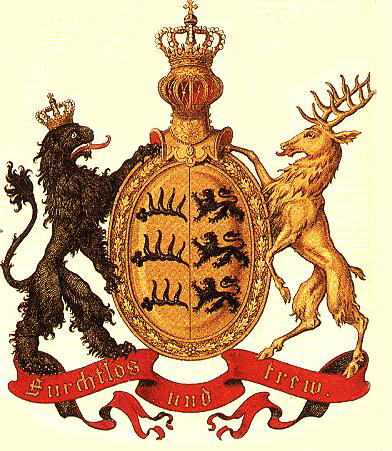
Our particular branch of the
Wolf family can be traced back as far as 1740 to
the area around Stuttgart in the province of
Württemberg in the southwestern corner of
Germany. Up until the end of the Middle Ages,
Württemberg had been a part of the duchy of
Swabia, which had enjoyed great prominence during
the reign of the Swabian-based Hohenstaufen
dynasty (1136-1250) of the Holy Roman Empire. 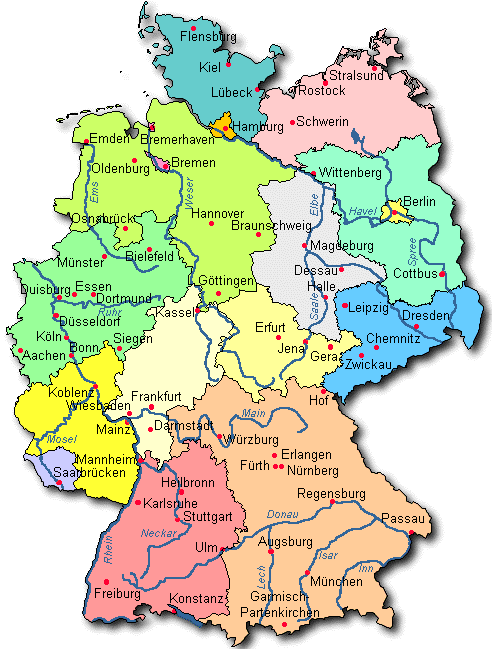 The civil wars that broke out upon the
death of Friedrich II in 1250 led to the political
fragmentation of late medieval Germany. By 1496
Württemberg had become a duchy in its
own right. Duke Ulrich, a vassal of the Habsburgs,
introduced the reforms of Martin Luther to
Württemberg in 1534. His son Christoph
(1550-68) took advantage of the compromise reached
at the Peace of Augsberg (1555) to impose
Lutheranism on his subjects, making it the
official state church of Württemberg. Duke
Friedrich (1593-1608) managed to secure the
duchy's independence from the Habsburgs in 1599
and was a principal organizer of the Protestant
Union (1608), which allied Württemberg to
other Protestant regions for the sake of
solidarity in the face of Catholic reaction. The
subsequent Thirty Years' War (1618-48), which
began in Bohemia but eventually spread throughout
Germanic Europe, hit the people of
Württemberg very hard as did the War of the
Grand Alliance a generation later (1688-93). As a
result of Duke Friedrich II's decision to work
with Napoleon rather than against him,
Württemberg not only grew territorially but
became an independent kingdom in 1806. King
Wilhelm I (1816-64) responded to liberal pressure
by issuing a constitution which featured a
bicameral legislature. But in the wake of the
March Revolution of 1848 and its violent
suppression in 1849, the kingdom of
Württemberg drifted toward more reactionary
policies. The rise of the Prussia under Bismarck
ultimately led Württemberg to relinquish its
independence altogether and join the newly unified
Deutschen Reich in 1871.
It is against this
historical backdrop, in particular the
transformation of Württemberg from a duchy to
an independent kingdom, that we can make out the
faint but unmistakeable traces left by five
generations of the Wolf family prior to its
relocation to America in 1853.
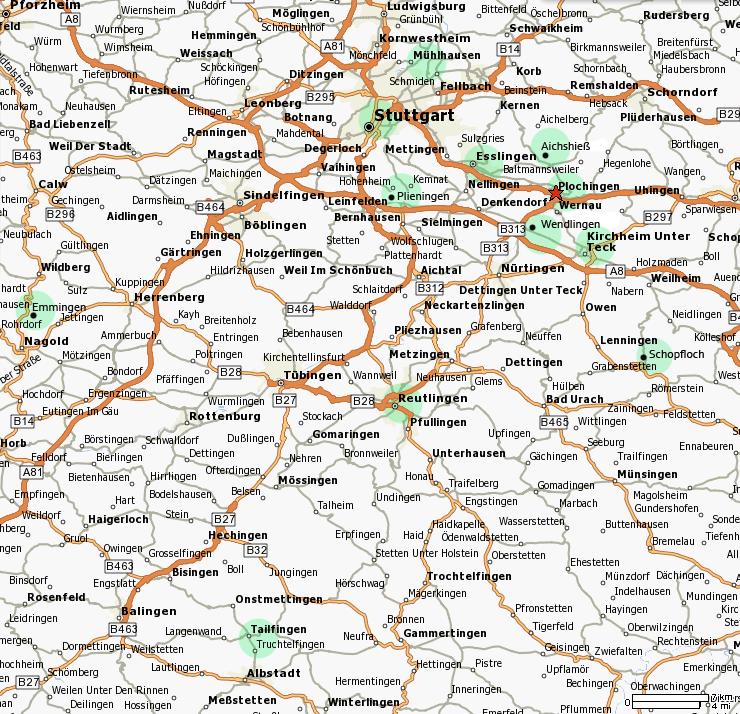
Plochingen is a small town fifteen kilometers southeast of Stuttgart, just up the Neckar River. It was there, on April 26, 1740, that a man named Johann Jacob Wolf purchased a half interest in the local flour mill from one Johann Jacob Burketh.1 Though there is some indication that the new miller came from the nearby village of Jesingen, just outside of Kirchheim, so far his name has not turned up in the Familienregister of that town.2 Be that as it may, by the time Johann Jacob bought into the mill he had been married to Christina Blessing (2/5/1710-2/19/1772), a native of Plochingen, for at least seven years.3 At that point the couple already had two children: a six-year-old son named Elias Wilhelm Wolf (1/?/1734-12/4/1805)4 and a five-year old daughter (1735-2/5/1742) whose name we do not know. At some point Johann Jacob's brother Hans Jerg Wolf (c. 1706-1746) joined him in Plochingen, though he died shortly thereafter.5
Johann Jacob served as
Müllermeister in Plochingen for more
than thirty years, dividing the profits with Georg
Friedrich Knoll, the owner of the other half of
the mill. The relationship between the two was
strained, however, by a disagreement over the
terms of their partnership. We know this because
at one point Johann Jacob Wolf actually appealed
to the ducal government of Württemberg6 to intervene. The official
response to his
request, dated January 25, 1760, advised Johann
Jacob to accept the original arrangements or seek
legal redress at his own expense.7 Despite this tension, the
two millers remained partners for another eleven
years, until Johann Jacob finally sold his half
share to Johann Martin Hofman on September 17,
1771. The contract for the sale of the mill has
survived.8 No sooner had
Hofman taken over ownership of Johann Jacob's
half, however, then he sold it to Johann Jacob's
old partner, Georg Friedrich Knoll! For the next
six years, Knoll would enjoy sole ownership of the
Plochingen mill.9
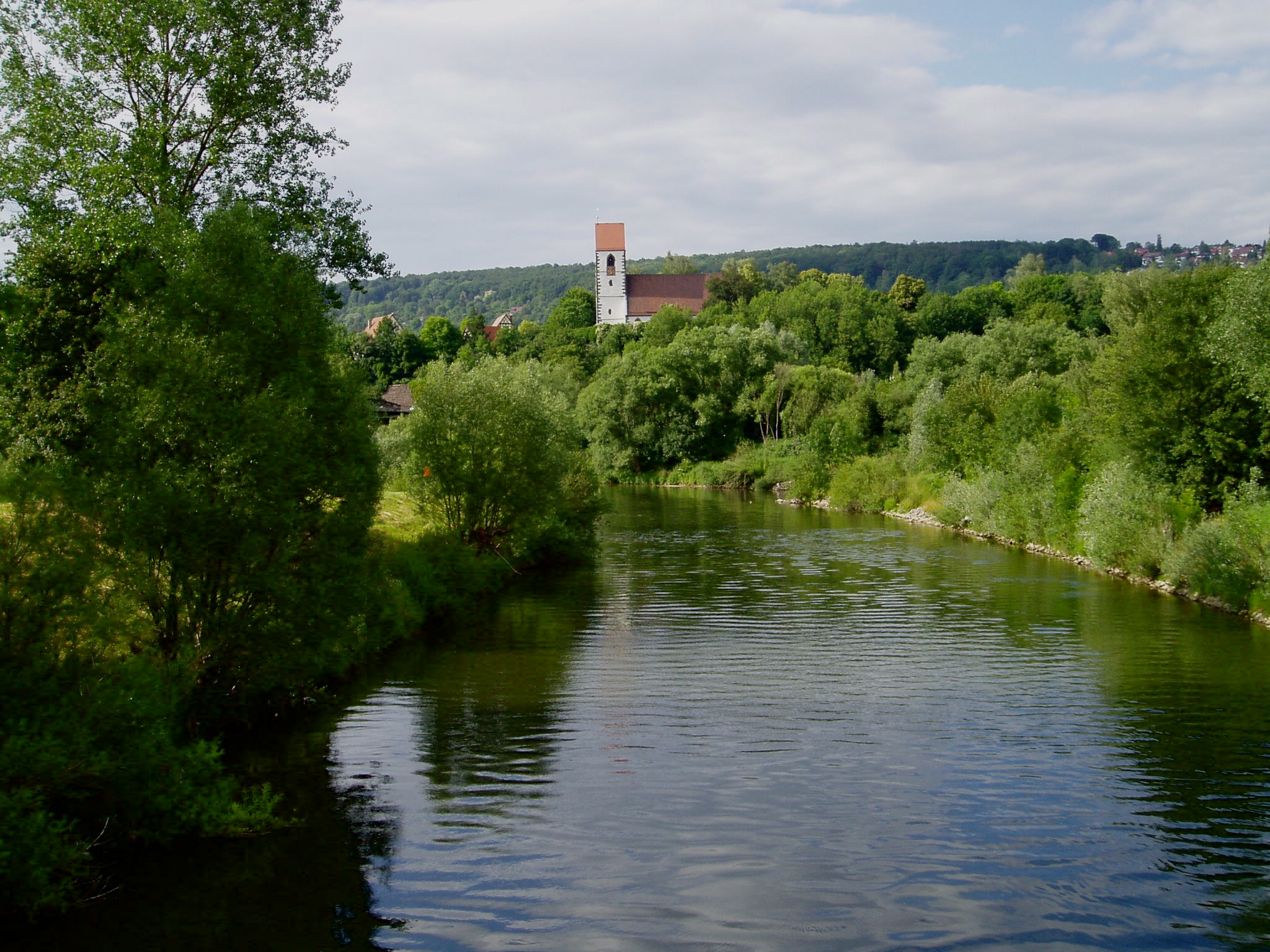

If Johann Jacob's
professional life as a mill owner had its rough
spots, they paled in comparison to those of his family life. The
Familienregister in Plochingen indicates
that less than two years after Johann Jacob
purchased his half-share of the mill, his
seven-year-old daughter drowned (2/5/1742) in the
very millstream that powered it. By then Christina
had already given birth to another daughter,
Anna Maria Wolf (born sometime between 1736
and 1740), who would survive to adulthood and
eventually marry (4/11/1758) a miller named
Konrad Weinhard, whose father (Gabriel
Weinhard) plied the same trade in the village of
Mittelstadt. But although Christina went on to
bear eight more children over the next twelve
years, none of them would live beyond the age of
three: "Anonymous girl" (10/30/1741--11/1/1741), "Anonymous boy" (7/6/1743), "Filius" (1745-2/18/1746), Johann Friedrich (1/19/1745-7/14/1748), "Anonymous girl" (10/31/1746--11/1/1746), Hans Michael (1747-5/9/1751), Elizabeth Magdalena (1/9/1751-2/11/1751), and Johann Wilhelm (2/23/1753--5/5/1756). When Christina herself died in 1772 at the age of 63, the immediate family of Johann Jacob (assuming he himself was still alive) consisted of only one son (Elias) and one daughter (Anna Maria), both of whom were in their
thirties.
Elias Wilhelm Wolf,
the first and only surviving son of Johann Jacob
Wolf, followed in his father's footsteps and
served as a master miller in Plochingen,
though, unlike his father, he was not a part owner
of the mill.
Johann Jacob Wolf
(II) began his professional life as a tenant
miller (Bestandsmüller) in the village
of Plieningen, seven kilometers south of
Stuttgart, but before long he returned to
Plochingen where he broke with family tradition
and became a baker.13
Records from Plochingen indicate that he regularly
paid his taxes to the local Brotbank
("Bread bank") for the privilege of marketing his
baked goods in town.14 At
the age of twenty-two Johann Jacob married
(10/8/1797) Eva Rosina Schmidt
(11/24/1774--12/30/1833) from Wendlingen, four
kilometers south of Plochingen. She was the
daughter of Johannes Schmidt and Maria
Barbara Brasch. The couple would have six children: Kunigunde
Wolf (b. 11/4/1797), Johann Jacob Wolf
(III) (3/16/1800--4/11/1848), Christian Friedrich Wolf
(1/30/1802--5/17/1837), Eva Rosina Wolf
(11/2/1805--11/14/1888), Anna Barbara Wolf
(b. 2/3/1810), and Anna Christina Wolf
(12/22/1811--7/16/1832). In marked and happy
contrast to the previous two generations of the
Wolf family, all of Johann Jacob and Eva Rosina's
children survived to adulthood. Kunigunde, the
oldest child, married (2/27/1821) a farmer and
vinekeeper by the name of Ludwig Gottlob
Gemsenjager. Johann Jacob Wolf (III)
became a teacher and married (9/6/1827) Heinrike Eberhardine
Baumgarth. Christian Friedrich Wolf who followed in his father's footsteps as a master baker in Plochingen,
married (2/13/1827) Regina Katharina
Maier.16 He would succomb to Tuberculosis (Auszehrung) at age 35. Eva
Rosina Wolf (11/2/1805-11/14/1888) married
(11/6/1827) a vine keeper by the name of
Christoph Friedrich Witzig. And Anna
Barbara Wolf (2/3/1810) married (9/24/1837)
Johann Jacob Pfulb. Only the youngest of the Wolf
children, Anna Christina, died (age 20) before
she had a chance to marry.17
Apparently Johann Jacob Wolf (III)'s first position as a teacher (Schullehrer) was in the village of Aichschieß, on the edge of the Schurwald forest just north of Plochingen. He was 27 when ( September 6, 1827) he married Heinrike Eberhardine Baumgarth (6/21/1796--11/28/1852). They married in Heinrike's hometown of Mühlhausen am Neckar (which, at the time, was referred to as Mühlhausen-Cannstatt, just north of Stuttgart), in the church where she had been baptized some 31 years before (on June 23, 1796). 18
Heinrike's father, Johann Gottlieb Baumgarth, served as a butler and gardener for the local nobleman, Baron (Freiherr) von Palm 19 in Mühlhausen am
Neckar. In the Nagold register, the pertinent entry
reads: "Johannes Baumgarth, herrschaftlicher
Hausvogt und Schloßgärtner in
Mühlhausen..." The name "Palm" appears in the
Tailfingen and the Aichschieß
Familiensregister. The von Palm family left
a bigger mark on nearby Eßlingen than on
Mühlhausen. The fourteenth-century
Stammhaus ("family house") of the von
Palms--with sixteenth-century modifications--is
located at Hafenmarkt 1 and is currently the
Ratskellar. The so-called "Palm'scher Bau"
(currently a restaurant in Eßlingen) was at
one time the Stadt-Palazzo of the von Palm
family. It was built between 1708 and 1710 by
Baron Jonathan von Palm after a fire in 1701
destroyed the previous palace. The baron's affairs
in Vienna meant that he rarely occupied his
Eßlingen residence. One of his successors,
Baron Franz Gottlieb von Palm, had a new palace
built between the years 1748 and 1751. Since 1841,
the building now serves as the "new"
Rathaus (City hall). It would appear that
Johann Gottlieb Baumgarth served as butler and
gardener for the family schloß in
Mühlhausen. It would appear that Johannes Gottlieb
Baumgarth's middle name was a product of his
father's ties to the baron. The
fact that many of the Baumgarth's who wished
Heinrike's children well in America (see below)
wrote from Vienna suggests that the extended
Baumgarth family served the barons in each of
their residences. Shortly after the birth of
Minna, the young family moved to Tailfingen, some
sixty kilometers south of Stuttgart, where Johann
Jacob accepted a position as
Schülmeister (schoolmaster).25 It appears, based on a memorial stone built
into the wall of St. Peter's church, that Johann
Jacob was hired to replace one Johannes Ribling
(Kibling?), who had served as schoolmaster until
his death in 1834. After the move to Tailfingen
came three more children: Eberhard Ludwig
Wolf (12/6/1835--c. 1863), a son (2/16/1838) who was either stillborn or died shortly after birth who was never given a name ("Anonymus"), and Amalie Louise
Wolf (5/30/1840--1/19/1926).26
The Tailfingen Familienregister indicates that Eberhard
was baptised there on December 11, 1835 and
Amalie, on June 17, 1840. Perhaps because of the distance between Plochingen and
Tailfingen, there were no family members among the
witnesses. Both baptisms were witnessed by Johann
Blickler, Schultheiß; Amalie Breyer,
the pastor's wife; and Johann Belthes Bizer, who
is identified as a Heiligensleger. Amalie
Wolf would seem to have been named
after Frau Breyer. The year after Amalia's
birth, the Wolf family moved again, this time to
Metzingen, just south of Plochingen, where Johann
Jacob taught in the local Knabeschül
(boys' school).27 The Wolf
family lived in Metzingen long enough for Gustav,
Wilhelm, and Wilhelmine to be confirmed in 1844,
1845, and 1846 respectively, as each child reached
the age of fourteen.28 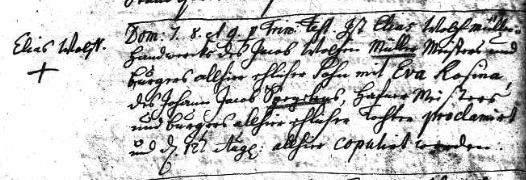 Elias was twenty six when he married (on August 12, 1760) Eva Rosina (a.k.a. Euphrosina) Spegel (9/27/1737--3/9/1798), a native of Plochingen and the daughter of Johann Jacob Spegel, a master potter, and his wife,
Maria Barbara Staudenmaier. Their luck in producing heirs was even worse than that of Elias' parents. Christina Barbara (6/8/1761--8/8/1764) died at age 3, Johann Jacob (12/24/1765--7/22/1770)--the first to take his grandfather's name--died when he was four. Three of the children did not even survive their births: Elias Ferdinand (10/18/1762), Eva Rosine (5/1/1772), and Christian Friedrich (12/21/1783). Johann Michael Wolf (11/11/1770--2/4/1795) managed to reach adulthood, only to die at age 25. In the end, Johann Jacob Wolf (II) (3/18/1775--3/21/1831), Eva Rosina's penultimate birth, was the couple's only child who would survive them and provide grandchildren. The name Johann Jacob was available to Elias and his wife only because their first child to bear that name had died four and a half years earlier.
Heinrike's mother was Barbara Röhner of
Schopfloch, some 25 kilometers southeast of
Plochingen. She and Johann Gottlieb married in 1790 and had eleven children: Carl Christian, Luise Friederike (5/30/1792-6/5/1863), Friederike Philippine (9/28/1793-7/3/1867), Karoline Friederike Luisa, Heinrike Eberhardine, Friedrich Ludwig, Auguste Karoline (5/7/1801-3/25/1870), Ferdinand Friedrich, Christian Heinrich (9/29/1805-8/22/1864), Johann Eberhard Jonathan, and Gustav Viktor Albert. 20
Johann Jacob Wolf (III) and his wife Heinrike would have seven children
altogether, five of whose lives would extend into adulthood. Their first child, Heinrike Wolf, was born on August 11, 1828 in Aichschieß, but died before she was a month old (9/9/1828). The next three births, all in Aichschieß in quick succession, had happier outcomes: 23 Gustav Friedrich Wolf (6/4/1830--8/23/1860), Wilhelm Christian Wolf Wolf (5/28/1831--12/10/1876), and Wilhelmine ("Minna" or "Mina") Wolf (7/18/1832--3/13/1912).24 Each was baptised in the little evangelishe kirche in Aichschieß.
 The Aichschieß Familienregister
gives the dates and names of the people who
witnessed the baptism of each of the three
children. Present at Gustav's baptism
(13 January, 1830) were his
maternal grandparents Barbara and Johann Gottlieb
Baumgarth; Johann Jacob's younger brother, Christian Friedrich Wolf,
"Beckermeister in Plochingen"; and Eberhardine's younger brothers: Friedrich [Ludwig] Baumgarth, who is identified as
a Schultheiß und Verwaltungsaktuar
(village mayor and administrative clerk) of the
village of Kirchhausen am Neckar, and who was accompanied by his wife, Regina Barbara; and Gustav
Victor Albert Baumgarth, "soldier of the Second
Royal-Imperial Infantry Regiment." This particular constellation of uncles helps account for the names that the young parents chose for their first son: Gustav Friederick.Present at
Wilhelm's baptism (June 7, 1831) were his
aunt Christiana (a.k.a. Anna Christina Wolf,
listed as "unmarried daughter of Johann Jacob
Wolf, Bürger und Beckermeister in
Plochingen") and, once again, his uncle Christian Friedrich
Wolf (Beckermeister in Plochingen).
Wilhelmine's baptism (July 31, 1832) was
witnessed by her uncle Christian Friedrich Wolf,
her aunt Kunigunde (along with her husband Ludwig
Gemsenjäger), and Friedrich Baumgarth, with
his wife, Regina Barbara.
On
April 11, 1848, Johann Jacob died in the prime of
his life at age 48. The Metzingen death register indicates that he "Schulmeister," died of pneumonia (Lungenentzündung). He was buried in Metzingen three days later.
Johann Jacob's widow Heinrike decided to leave Metzingen with her their
children--ranging in age from eight to
eighteen--and move to Emmingen-am-Nagold (that is, on the Nagold
River), some forty kilometers southwest of
Stuttgart.29
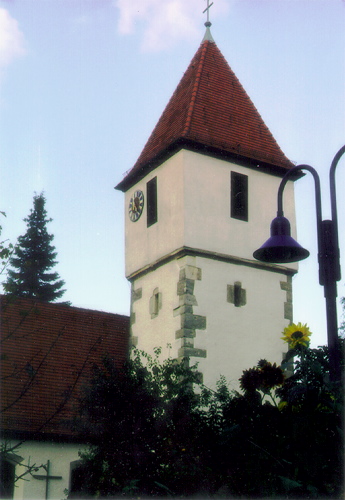
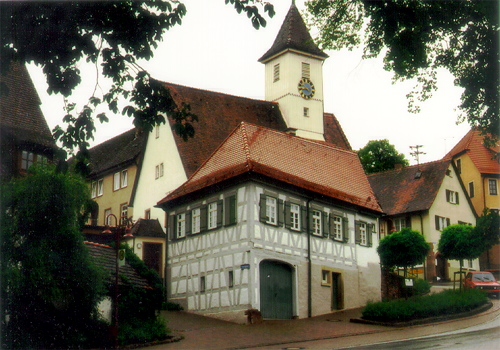
Before moving on the the
American segment of this family line, it may be of
some interest to consider the possibility that
there are "Wolfs" from Johann Jacob Wolf (I)'s
line who are still living in the Vaterland.
Because Johann Jacob (III)'s sons all emigrated to
America, we have to look back to previous
generations of male Wolfs for promising links. The
most immediate candidate would be Johann Jacob
Wolf III's younger brother Christian Friedrich
Wolf (1/30/1802-5/18/1837) who was born in Plochingen, where he worked as a baker. He
died young (age 35) from tuberculosis (Auszehrung). His only surviving son, Christian Friedrich Wolf (II)
(10/31/1832--8/2/1878), married (8/8/1860) a
woman from Stuttgart named Pauline Sofie
Hertner (daughter of Johannes Hertner
and Christiana Paur of Stuttgart). That
same year Christian Friedrich Wolf (II) began his
new life as a master bookbinder in Stuttgart. The
couple had four children between early February
1861 and late May of 1870, but only the last of
these survived infancy. That was Pauline
Wilhelmine Sofie Hertner (5/29/1870-3/27/1956)
who moved to Schwäbisch Gmund, lived to be 85
years old, but never married. Of course even if
she had, her children would not have carried the
Wolf name. Since neither Johann Jacob Wolf II nor
his father Elias had any brothers who lived long
enough to marry and produce children, one would
have to go back all the way to to the generation
of Johann Jacob Wolf I whose brother Hans Jerg
Wolf might have fathered a parallel line of Wolfs.
But so far we have been able to turn up nothing
about Hans Jerg's family nor about his and his
brother's origins. Having neither of their
birthdates makes it very difficult to pin them
down in any of the records in Jesingen, where
Johann Jacob apparently worked as a miller before
he bought half of the mill in Plochingen.32 Of course if one were to
broaden the scope of this "search for relatives in
Germany" to include non-Wolfs, the possibilities
are much greater, beginning with the Baumgarth
family.
Click on the
following links for pictures of German towns and
villages that figure prominently in Wolf family
history:
Part Two: The Wolf Family in America: 1853-1969
For more information about
this branch of the Wolf family, contact: Ken
Wolf (Gustav's great-great grandson): kwolf@pomona.edu
Special thanks to:
- W. John Wolf, for his work on the descendants of Gustav, William, Mina, and Amalia Wolf.
- Greg Myers, for his work on the descendants of Eberhard Wolf.
- Walter Wolf, Jr., Helen Wolf Shanteau, Carol Wolf Marshall, L. Eugene Ernst, and the late Bob Wolf, for their memories of Walter Wolf, Sr., and his family.
- Tana Salvaggio, for her work on the Baumgarth line.
- Friederike von Franque, for her indispensable assistance with the German sources.
- The former German Genealogical Society of America whose library has recently been added to that of the Southern California Genealogical Society in Burbank, CA.